
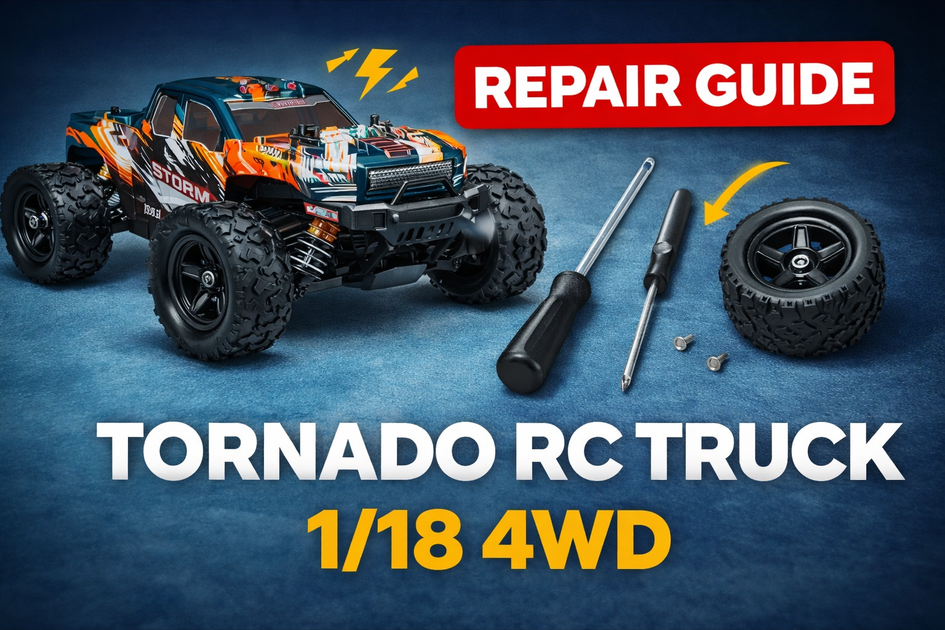
Tornado RC 1/16 4wd Truck Repair Guide
Posted by Alex on 24th Feb 2026
Troubleshooting Guide: Tornado RC 1/18 Hight Speed Trucks
Applicable Models: TRC-18301, 18302, 18311, 18312, 18321, 18323 and many more!
This guide covers six common faults you could experience when pushing your Tornado storm high speed truck to its limit.
Required Tools
-
Small Phillips head screwdriver (included with vehicle)
-
5.5mm hex driver, nut driver, or socket (wheel removal)
-
Clean workspace with organised screw storage
For advanced diagnostics (recommended):
-
Digital multimeter (battery voltage checks)
1. Vehicle Unresponsive (No Throttle or Steering)
Step 1: Verify Transmitter Operation
-
Install fresh AA batteries.
-
Power on transmitter.
-
Confirm LED behaviour:
-
Rapid flashing: Ready to bind.
-
Slow flashing: Steering trim not centred.
-
If LED flashes slowly:
-
Power off transmitter.
-
Adjust steering wheel slightly.
-
Power on and observe LED.
-
Repeat until rapid flash occurs.
Step 2: Bind Sequence
-
Power on transmitter (LED rapidly flashing).
-
Power on vehicle.
-
Confirm solid LED or steering twitch (bind confirmation).
If Still Unresponsive
Check:
-
Battery pack voltage (should be 8.4v if its fully charged).
-
Battery connector integrity (no loose pins).
If voltage is correct and no binding occurs, suspect:
-
Failed ESC/receiver board.
-
Faulty on/off switch.
-
Internal wiring break.
2. Vehicle Veers to the side
first try using the steering trim on the controller to centre the wheels but if that doesn't work:
Mechanical Re-Center Procedure
-
Set steering trim to neutral.
-
Power vehicle ON (allow servo to centre).
-
Remove servo saver screw.
-
Lift servo horn off spline.
-
Reinstall horn so wheels sit straight.
-
Tighten screw until spring is compressed but not coil-bound.
If Steering Still Erratic
Likely causes:
-
Stripped servo gear. or output spline
-
Cracked servo saver.
Replace servo saver or complete servo if necessary.
3. One Wheel Not Driving
If a wheel spins freely:
Differential Test
-
Power off vehicle.
-
Lift vehicle off ground.
-
Rotate one wheel by hand.
Expected:
-
Opposite wheel rotates in opposite direction with light resistance.
If:
-
Wheel spins freely with no resistance → broken driveshaft.
-
Driveshaft turns but wheel does not → stripped hex or hub.
-
Grinding noise → damaged diff gears.
Replace damaged drives shaft (dogbone/CVD).
Ensure drive cups are intact and any pieces of the old driveshaft are removed before installing new shaft.
4. Vehicle Leaning / Sagging
Common cause: failed shock absorber.
Inspection Checklist
-
Detached lower shock eyelet.
-
Bent shock shaft.
-
Broken spring retainer.
Replace damaged shock.
Ensure ride height is equal left-to-right after installation.
If shocks are intact:
-
Check suspension arm for cracks.
-
Inspect hinge pins for bending.
5. Wheel Wobble / Instability
Step 1: Wheel Nut Torque
Tighten 5.5mm wheel nut securely. Do not overtighten.
Step 2: Wheel Inspection
Check for:
-
Cracked rim.
-
Tyre fallen off the rim.
Replace if deformed or reinstall the tyre by popping it back onto the rim.
Step 3: Axle & Drivetrain
Remove wheel and inspect:
-
Bent axle shaft.
-
Excessive play in bushings/bearings.
-
Damaged hex adaptor.
Excessive lateral movement indicates worn bushings or bearings. Replace as required.
6. Short Run Time
Battery-Related Causes
-
Weak cell in pack.
-
Battery not fully charged.
-
High internal resistance (aging pack).
Check pack voltage after charge:
-
Li-ion 2S: ~8.4V full when measured at the output connector
- 4.2V for each cell when measuring adjacent pins on the charging connector
If one cell measures significantly lower → replace pack.
Mechanical Load Causes
-
Binding drivetrain.
-
Debris in gears.
-
Over-tightened wheel nuts.
-
damaged or worn motor.
Spin wheels by hand. Drivetrain should rotate freely with minimal drag.
carefully try and push the car along a flat smooth surface. If there is resistance inspect the drivetrain for binding
Summary
Breaking things is part of the RC hobby and the beauty of these little cars is that any issue you encounter is easily fixable with simple tools, a spare part and a bit of time.
If any of these steps sound too daunting for you to attempt we do offer RC repairs as a service at Hobbyrama in Stafford.
Happy driving and wrenching!